


... boosting your innovation with engineering and manufacturing solutions in the cloud...

Open Innovation Platform for optimising production systems by combining product development, virtual engineering workflows and production data.
App related to Cloud-based Solutions Digitalization for Manufacturing Engineering Workflows Semantic Interoperability in the context of Construction Manufacturing Motor Vehicles and (Semi-) Trailers
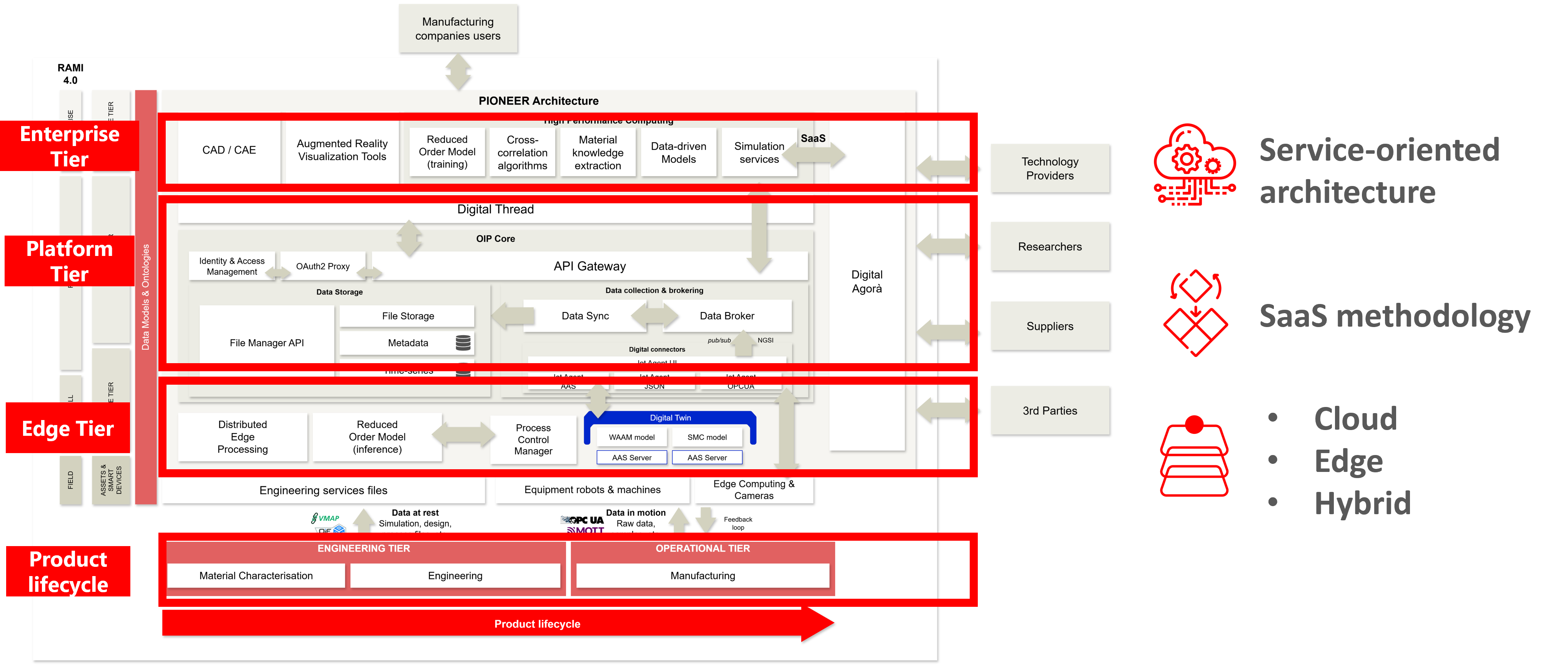
Description:
The Open Innovation Platform (OIP) integrates materials, products, and processes to enhance the efficiency of the manufacturing processes. To this end, product specifications, all information related to material properties and materials modelling, as well as information collected from manufacturing processes and product quality criteria, must be accessible and ensured along the product lifecycle from the initial design and conceptualisation.
The OIP core serves as a bridge between different applications, services, or databases, enabling them to communicate and function together. It offers the ability to simplify and streamline the communication, integration, and scalability of complex systems, enhancing the overall efficiency and agility of business operations. It leverages a modular open-source approach allowing the user to choose the best components to be deployed in the manufacturing context and the usage of standards to facilitate data exchange among several applications.
The OIP Core is part of the Open Innovation Platform and ensures that different enterprise applications, such as Product Lifecycle Management (PLM), Manufacturing Execution Systems (MES), Digital Thread and others, can seamlessly share data and interact with each other. It enables the deployment and operation of several types of services.
It is based on a service-oriented architecture and focuses on the implementation of SaaS methodology integrating manifold software solutions and data-services. It enables data acquisition from a variety of resources (smart sensors, other legacy systems, etc.); pre-processing of data for an efficient dispatching to other PIONEER components and deployment services; data analysis using algorithms running on top of OIP Core modules.
OIP Core is based on open source FIWARE and Apache components and guarantees security using the standard protocol OAuth 2.0 (based on Keycloak), leveraging this way the support of a big community for enhancements and problem resolution.
A variety of additional services complement and enhance the solution provided. These services can improve efficiency, security, and overall functionality, depending on the deployment model used.
Use Case:
The OIP core has three main deployment models:
Dependencies: